


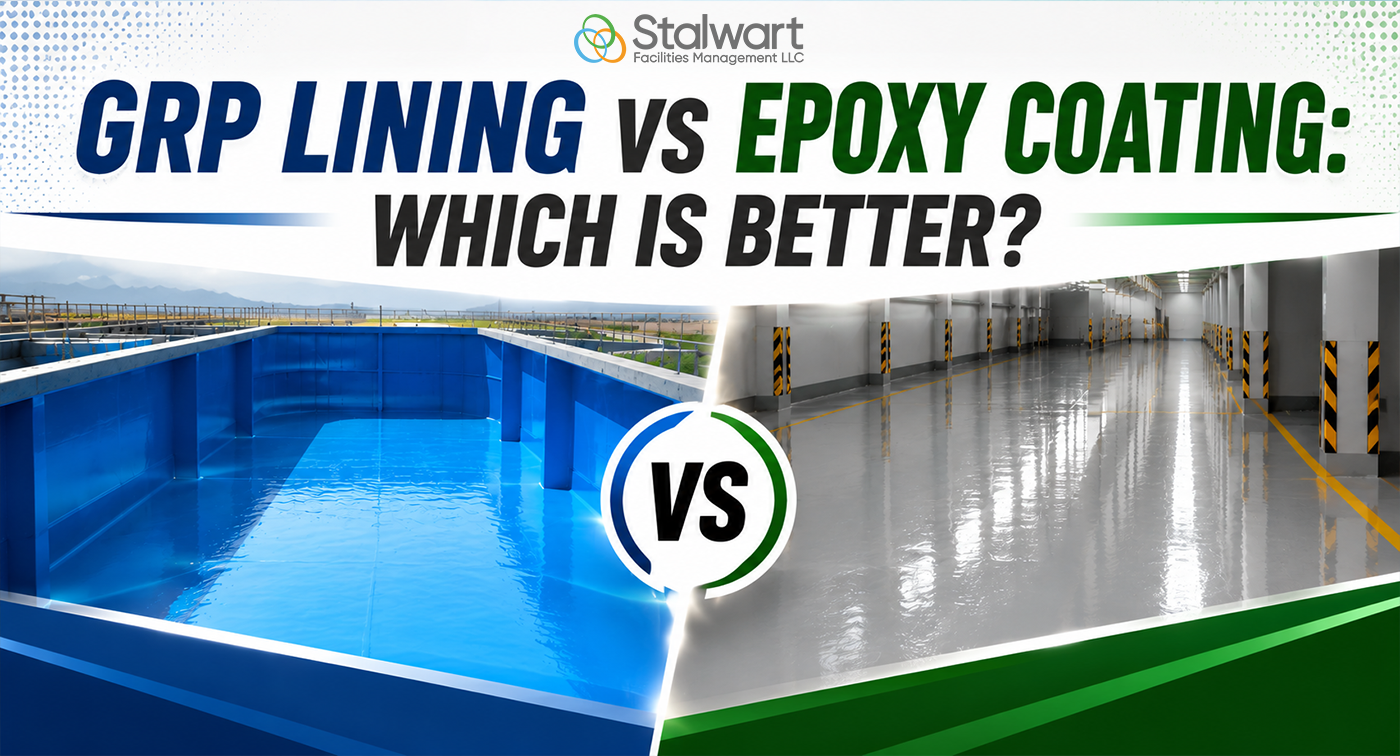
In Oman’s harsh climate, industrial facilities, commercial buildings, and water storage systems face continuous exposure to heat, humidity, moisture, and chemical reactions. Over time, these conditions can lead to corrosion, leaks, cracks, and structural damage — especially in water tanks, wastewater systems, pipelines, and concrete structures.
To protect these surfaces, two commonly used solutions are GRP Lining and Epoxy Coating. While both are designed to improve durability and corrosion resistance, they differ significantly in terms of strength, lifespan, application, and long-term performance.
Choosing the right solution is important for industries in Oman, where high temperatures and saline conditions accelerate deterioration.
In this blog, we compare GRP lining and epoxy coating in detail to help property owners, facility managers, and industrial operators make the right decision.
What is GRP Lining?
GRP (Glass Reinforced Plastic) lining is a protective waterproofing and corrosion-resistant system made by combining fiberglass mat layers with specialized resin.
Once applied, it forms a strong, seamless, non-porous protective layer over surfaces such as concrete, steel, or metal tanks.
GRP lining is widely used for:
- Water tanks
- Wastewater tanks
- Chemical storage tanks
- Pipelines
- Industrial flooring
- Concrete structures
One of the biggest advantages of GRP lining is its structural reinforcement capability.
Unlike ordinary coatings, GRP becomes part of the surface itself, adding strength along with protection.
What is Epoxy Coating?
Epoxy coating is a resin-based protective coating applied over concrete or metal surfaces to create a smooth and chemically resistant layer.
It is commonly used in industrial floors, pipelines, tanks, and machinery because of its adhesive and anti-corrosion properties.
Epoxy coatings are popular for:
- Industrial flooring
- Warehouses
- Pipelines
- Light-duty tanks
- Manufacturing facilities
Epoxy coatings provide excellent surface sealing and chemical resistance, but they are generally thinner and less structurally strong compared to GRP lining systems.
Why Corrosion Protection Matters in Oman
Oman’s environment creates several challenges for buildings and industrial infrastructure:
- High temperatures
- Coastal humidity
- Salty air exposure
- Groundwater moisture
- Industrial chemical exposure
These conditions accelerate corrosion and waterproofing failures, particularly in older structures and water systems.
Industries such as oil & gas, desalination, hospitality, manufacturing, and commercial real estate in Oman require durable waterproofing and anti-corrosion solutions.
Which is Better for Oman?
For Oman’s demanding climate and industrial conditions, GRP lining is generally the better long-term solution.
It is especially recommended for:
- Water tanks
- Wastewater systems
- Industrial facilities
- Chemical storage areas
- Concrete waterproofing
- Corrosion-prone structures
Epoxy coating remains a good option for lighter-duty applications, flooring systems, and projects with budget limitations.
Conclusion
Both GRP lining and epoxy coating are effective protective solutions, but they serve different purposes.
Epoxy coating is suitable for moderate environments and cost-sensitive applications, while GRP lining delivers superior strength, waterproofing, durability, and long-term protection.
In Oman’s climate, where corrosion and water leakage are major concerns, investing in a durable solution can help avoid costly repairs, downtime, and structural damage in the future.
At Stalwart Facilities Management, we provide
professional GRP Lining services
for water tanks, industrial facilities, concrete structures, and corrosion-prone systems across Oman.


